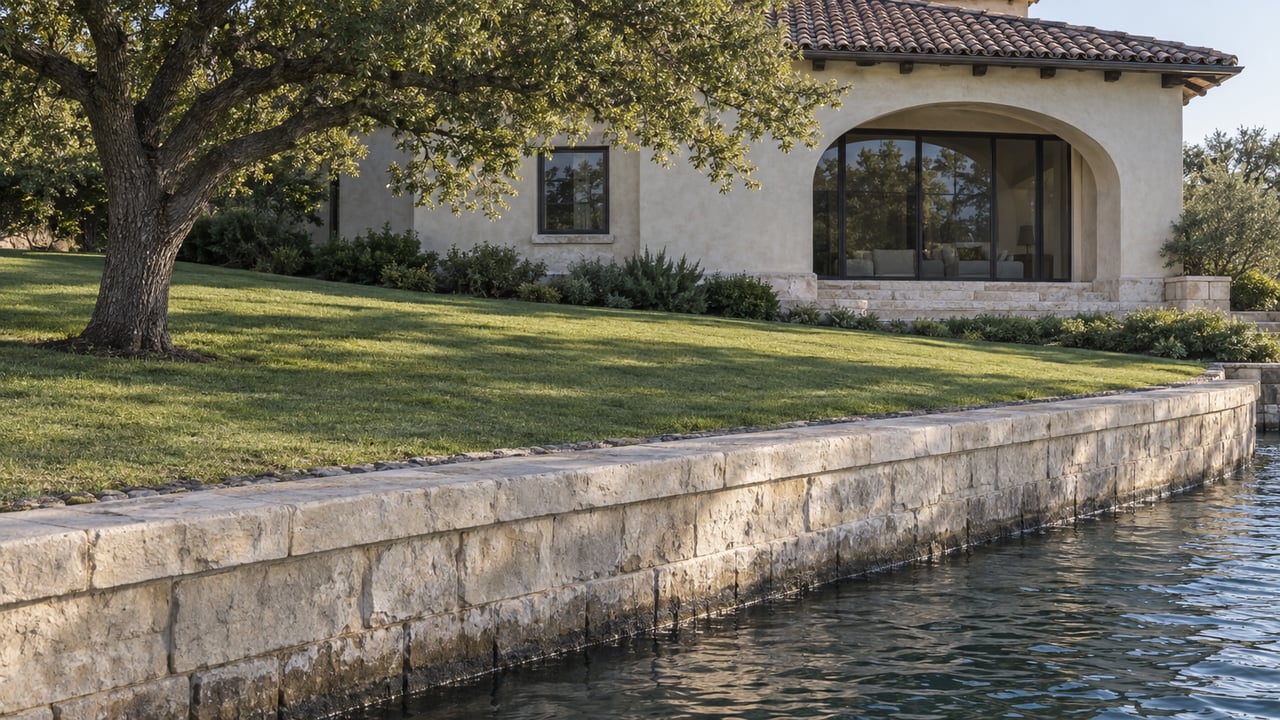
Sometime in 2025, a boat on Eagle Mountain Lake hit a dock. The Tarrant Regional Water District's own officers later cited it as a reason the rules had to change. "Even last year, we had a watercraft strike a dock, and they violated the 100-foot ordinance," TRWD Lt. Chris Akers told The Azle News in February. His point was that the old buffer should have made the collision impossible. "There are no docks that are more than 100 feet away from the land."
The TRWD board responded with more than a bigger buffer. On December 16, 2025, it adopted a new General Ordinance that repeals and replaces the one first adopted in 2002 and last revised in 2011. Residential permit guidelines followed and took effect February 5, 2026, with some highlighted sections taking effect April 4. Together they extend the district's authority over a lakefront lot in two directions at once: farther out onto the water, and farther up toward the house.
Two hundred feet, measured from your dock
The new rule is short. Any watercraft moving faster than headway speed, which TRWD describes as essentially idle with little or no wake, has to stay at least 200 feet from shorelines, docks and other vessels. Texas law sets the distance at 50 feet. TRWD's old ordinance used 100. Akers said the district's stricter standard governs on district-controlled water.
From a homeowner's side of the water, that line now starts at the end of your own dock, so boats at speed have to keep their distance from the structure you maintain. Akers said docks on this lake don't reach past 100 feet. Under the old rule, a fast boat could legally pass close to the tip of a long dock. The 200-foot buffer moves that traffic well past it.
The officers gave two pressures behind the change. Akers said boat traffic has grown every year since he joined TRWD's Law Enforcement Division in 2005, and has climbed especially since 2020:
"If you took Lewisville and shrunk it down to our lake, we would have more boats in it than Lewisville, so we're steadily increasing."
Sgt. Rick Odom pointed to the shoreline itself. New subdivisions are going in around the lake, and "everybody's getting their own dock." He also said the three- to five-foot wakes thrown by wake surfing damage "boat docks, boat houses — everything." Akers expected wake surfers to feel the change most, since some like to get close to shore for a better wave. The 200-foot figure matches what the Water Sports Industry Association already asks of its own community through its Wake Responsibly campaign, which tells riders to stay at least 200 feet from docks and beaches.
Akers said the rewrite drew on community input, including from Save Eagle Mountain Lake, the nonprofit dedicated to preserving the lake. In February he expected a grace period that would "probably" last through the year, handled case by case, with signs at the boat ramps by Memorial Day. Those were plans he described before the season. We found no reporting since then on how enforcement actually went this summer.
The same rewrite, read from the shore
The water buffer got the headlines. The bigger change for owners is on land, and it shows up when you put the old Eagle Mountain permit guideline next to the 2026 version.
| Older Eagle Mountain guideline | 2026 Residential Improvement Permit Guidelines | |
|---|---|---|
| What triggers a permit | Construction or fill at or below elevation 649.00 | Building or modifying an improvement on District Land or District Water |
| Items named | Docks, retaining walls, dredging, raw-water irrigation | Docks, boathouses, patios, fire pits, outdoor kitchens, cabanas, retaining walls, waterfront irrigation, swimming pools, storage structures, fences, dredging |
| Application fee | $100 | $300 |
| Extension fee | $50 | $150 |
| Review time | Allow 10 working days | 10 business days for completeness review, then up to 30 business days of technical review once all information is in |
| Inspections | Not itemized | Up to $50 per visit |
The first row carries the most weight. The new ordinance defines "District Land" to include all land the district owns or controls, "and all pipelines, flowage, and other easements held by the District." On Eagle Mountain Lake, the ordinance sets the spillway elevation at 649.1 feet and the Flood Flowage Boundary at 668 feet. The older guideline described a flood easement the district bought covering the band between 649 and 668.
Put those together and an outdoor kitchen, pool or fence on a lot where TRWD holds that easement falls under the same permit as a boathouse. TRWD's published documents don't confirm that every lot around the lake carries the easement across the full 649-to-668 band. The deed and survey for each lot answer that question. The district's own summary describes the new scope as "clarified to explicitly cover all District land and water."
Septic systems follow the same logic. A permit is required before building a new on-site sewage facility, or modifying an existing one, on District Land or District Water. The guidelines prohibit surface-irrigation effluent disposal. Systems installed before April 8, 2011 can stay if they are properly permitted and kept under a current service contract with quarterly testing and reporting.
What a dock is allowed to be in 2026
The size formula carried over from the older guideline almost unchanged. The maximum footprint of a shoreline improvement still depends on how much shoreline the lot has:
- 8 square feet per linear foot of shoreline up to 150 feet, for a maximum of 1,200 square feet
- 4 square feet per foot from 151 to 250 feet, up to 1,600 square feet
- 2 square feet per foot from 251 to 450 feet, up to 2,000 square feet
- 1 square foot per foot beyond 450 feet
The building rules around that footprint are more detailed now. A structure has to sit at least 5 feet from side property lines, or 20 feet once it exceeds 1,200 square feet. Side-entry slips need clearance of one and a half times the slip length. Docks are limited to two stories, with no three-story sun decks and no toilets. Potable water can run to only one fish-cleaning station on the lower deck. No dock is allowed on a lot where a house can't be built. Every structure built over the spillway elevation needs weather-resistant reflective lettering of at least four inches showing the owner's 911 address.
The lighting rules tie the dock back to the boating rule. Structures that reach more than 50 feet from shore need dusk-to-dawn lighting at the outermost point. It has to be white, fully shielded, aimed onto the structure and built on DarkSky-compliant principles to limit glare for boaters and neighbors. Structures over the spillway elevation also need white reflectors at least three inches across, spaced no more than 20 feet apart along every outer edge. The water rule keeps fast boats 200 feet back, and the dock rules make sure the dock can be seen from that distance after dark.
Applications now go through the MGO Connect permit portal linked from TRWD's permits page. The guidelines also say TRWD may approve or deny shoreline improvements "in the District's sole and absolute discretion."
Where the new text still needs a phone call
The rewrite leaves some questions open, and owners planning work should get them answered directly by TRWD.
Deck height. The older Eagle Mountain guideline put the lower deck at least 18 inches above elevation 649. The 2026 guideline says at least 18 inches above the Flood Flowage Boundary. On this lake, the ordinance sets that boundary at 668 feet. Meanwhile, TRWD's own drawing-requirements sheet for boathouses, docks and piers still says 18 inches above normal pool. The two TRWD documents don't agree, and anyone drawing plans should get the district's answer in writing before a contractor sets a single piling.
Existing structures. The guidelines require a permit for any new improvement and for "any Modification." The published text doesn't say whether older patios, fences or docks built under the previous rules are grandfathered, or whether a dock's permit history carries over when a home sells. If you're adding a second story to a boathouse or replacing a fence near the waterline, ask that question first.
Future revisions. Section 3.02 of the adopted ordinance directs district staff to review and revise it as needed and to present revisions to the board "no more than every five years from the date of first adoption." The 2002 ordinance went nearly a quarter century without a full rewrite. The current one carries a review schedule in its own text, and because the permit details now sit in separate guidelines, TRWD can update them without reopening the whole ordinance.
Akers pointed readers to TRWD's website for the full ordinance and a summary of the changes. He said questions can go to the TRWD dispatch center at 817-720-4584.
If you're weighing a dock expansion, a new outdoor kitchen near the water, or the sale of a lakefront home with older shoreline structures, Raleigh Green can help you work out which parts of your lot fall under TRWD's permits and what that means for your plans and your property's value. Request a private consultation.